Resources

Assistive Listening Resources

Further your knowledge of Assistive Listening Technologies with useful resources provided by industry experts.

Standards

Standards are established guidelines and criteria that define the parameters for the design and performance of a hearing loop system.

Technical Resources

A range of technical resources and documentation aimed at demystifying Assistive Listening tech.

Standards

Link Directory

Find key links to international standards, professional bodies, and advocacy organisations advancing hearing accessibility worldwide.
Glossary

A
ADA Standard 219

Refers to the American Disabilities Act (ADA) General Guidelines (2010) Section 219 which require assistive listening systems in spaces where communication is integral to the space and audio amplification is provided and in courtrooms.

Assistive Listening Technology

A device or system that enables people with hearing loss to access sound being transmitted through a sound system or public address system.

Audio over WiFi

Enables wireless transmission of audio via a WiFi network, allowing the user’s own device (smartphone or tablet) to act as the receiver.

B
Bluetooth / Bluetooth Classic

The Bluetooth Classic radio, also referred to as Bluetooth Basic Rate/ Enhanced Data Rate (BR/EDR), is a low power radio that can continuously stream data over 79 channels in the 2.4GHz unlicensed industrial, scientific, and medical (ISM) frequency band.

Bluetooth LE (BLE):

The Bluetooth Low Energy (LE) radio is designed for very low power operation. Transmitting data over 40 channels in the 2.4GHz unlicensed ISM frequency band like Classic Bluetooth. However, BLE remains in sleep mode constantly except for when a connection is initiated. Power consumption is lower and data rates are higher than Classic Bluetooth but connection is not continuous

BS 8300

Design of buildings and their approaches to meet the needs of disabled people. Code of practice. BS 8300 looks at the design of buildings and their ability to meet the requirements of disabled people. By offering best-practice recommendations, this standard explains how architectural design and the built environment can help disabled people to make the most of their surroundings.

D
Decibels (dB)

A decibel (dB) is a unit measurement of amplitude, or the intensity, pressure or forcefulness of a sound. 0dB is near silence, 10dB is 10x louder than near silence, but as the dB scale is logarithmic 20dB is 100x louder than near silence.

E
Electromagnetic interference (EMI)

EMI is the interference caused by one electrical or electronic device to another by the electromagnetic fields generated by its operation.

BS EN 17210

Accessibility and usability of the built environment. Functional requirement. This document describes basic, minimum functional requirements and recommendations for an accessible and usable built environment which will facilitate equitable and safe use for a wide range of users, including persons with disabilities.

F
FM (frequency modulation) radio

Radio waves are electromagnetic waves of frequency between 30 hertz (Hz) and 300 gigahertz (GHz). Frequency modulation or FM is a form of modulation of a radio signal which conveys information by varying the frequency of a carrier wave.

H
Hearing Loop

Hearing loops, audio induction loops, or audio frequency induction loops (AFILs) are an assistive listening technology that uses a loop or loops of cable or copper tape around a room or area. An amplified sound signal from a sound system or microphone is input into a hearing loop driver or amplifier which in turn drives a current around the loop creating an electromagnetic field. That field can then be picked up by a Telecoil / T-coil in a hearing aid, cochlear implant or loop receiver which transmits the received signal into the devices amplifier and speaker and into the ear.

Hearing Loss

Hearing loss is a common problem caused by noise, aging, disease, trauma and heredity. The four different levels of hearing loss are defined as: Mild (25-45dB loss), Moderate (40-75dB loss), Severe (75-90dB loss) and Profound (>90dB loss.

I
IEC60118-4

System performance requirements. Electroacoustics – Hearing aids – Part 4: Induction-loop systems for hearing aid purposes. The performance criteria for hearing loops are set out in standard IEC- 60118-4 and include:

• low magnetic background noise - for intelligibility and comfort

• correct field strength - setting a suitable signal level

• even field strength - for consistency of signal

• flat frequency response - essential to maintain intelligibility

IEC 62489-1

Electroacoustics - Audio-frequency induction loop systems for assisted hearing - Part 1: Methods of measuring and specifying the performance of system components This standard applies to the components of audio-frequency induction￾loop systems for assisted hearing. This standard is intended to encourage accurate and uniform presentation of manufacturers’ specifications, which can be verified by standardized methods of measurement.

Infrared

Infrared (IR), sometimes called infrared light, is electromagnetic radiation (EMR) with wavelengths longer than those of visible light. It is therefore invisible to the human eye. An infrared sound system consists of infrared transmitters, radiators and receivers. The radiator produces infrared light from an input source supplied via the transmitter and captured via a microphone or PA source. Wireless, IR receivers convert the light signal into an audio signal that can be listened to using headphones or connected to a hearing aid via neck-loop.

L
Latency

Latency is a short period of delay (usually measured in milliseconds) between when an audio signal enters a system and when it emerges. Potential contributors to latency in an audio system include analog￾to-digital conversion, buffering, digital signal processing, transmission time, digital-to-analog conversion and the speed of sound in the transmission medium. Latency can be a critical for assistive listening solutions and sound reinforcement systems. Excessive audio latency can significantly a users experience.

Loop receiver

A loop receiver is a device fitted with a Telecoil / T-coil allowing it to pick up signals from a hearing loop. This enables those without hearing aids or cochlear implants to hear the audio output of a loop system.

O
OEM

An original equipment manufacturer (OEM) is generally perceived as a company that produces parts and equipment that may be marketed by another manufacturer.

S
Signage

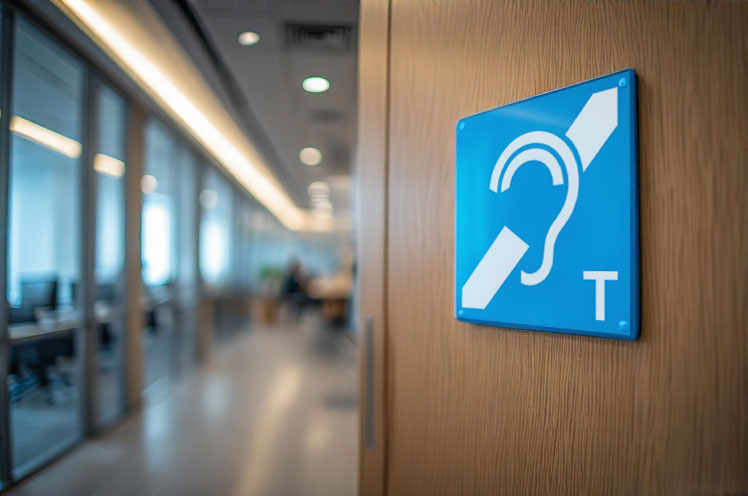
Signs indicating the availability of a hearing loop or other assistive listening technology are an essential part of an assistive listening system. It allows users to identify where a service is available and, in the case of hearing loops, hearing aids and cochlear implants, discreetly switch their device over to the T or MT setting giving them access to the audio output of the loop. For WiFi systems signs can point to an app using a QR code or web link. For other technologies such as Infrared or FM/Radio correct signage indicates a service is available and where to obtain a receiver.

Signal to noise ratio

SNR or signal-to-noise ratio is the ratio between the desired information or the power of a signal and the undesired signal or the power of the background noise.

T
Telecoils, T-coils

A telecoil is a small coil of wire wrapped around a small rod inside most behind the ear, receiver in the ear and open fit hearing aids. The coil works as a small receiver which picks up signals from a hearing loop system or neck loop that acts as an electromagnetic field. Hearing aids with an activated telecoil can convert this electromagnetic field into a sound signal.

W
WiFi

WiFi: WiFi is a family of wireless network protocols, based on the IEEE 802.11 family of standards, which are commonly used for local area network￾ing of devices and Internet access, allowing nearby digital devices to exchange data by radio waves.